
[Professionals' Selection] 8 Recommended Barbells | 9 Points to Consider When Choosing

"I'm thinking of buying a barbell, but I don't know which one to choose."
"I want to train at home, but which barbell do you recommend?"
When you start looking for a barbell, you'll find so many types from so many manufacturers that many people probably feel overwhelmed and don't know which one to buy.
Our recommended barbells are as follows:
[Our Top Picks] Recommended Barbells
| Recommended Purpose of Use |
Manufacturer | Product Name | Price |
| Training focused on the BIG 3 |
REP Fitness |
 |
32,900 yen (incl. tax) |
| REP Fitness |
Double Black Diamond Power Bar  |
51,800 yen (incl. tax) | |
|
Commercial Gyms |
REP Fitness |
 |
57,300 yen (incl. tax) |
| IVANKO |
 |
63,800 yen (incl. tax) | |
| Powerlifting Competitors |
REP Fitness |
Double Black Diamond Power Bar |
51,800 yen (incl. tax) |
| ELEIKO |
IPF Stainless Steel Powerlifting Training Bar  |
196,100 yen (incl. tax) | |
| Weightlifting Competitors |
REP Fitness |
 |
29,900 yen (incl. tax) |
| ELEIKO |
 |
213,100 yen (incl. tax) |
A barbell is an "Olympic weight" used in weightlifting and powerlifting competitions, consisting of a shaft (the bar itself) and plates (the weights).
Generally, the bar section (shaft) is called a "barbell," and the plates are called "barbell plates."

In addition to these competitions, barbells are also widely used in weight training (muscle training), and recently, more and more people are setting up barbells at home for training.
When purchasing a barbell, it is important to choose based on your intended use and the type of training you'll be doing.
If you purchase based solely on "price" or "reviews," there's a chance that it will be difficult to use for your desired training or that it won't last long.
Therefore, this article will explain in detail how to choose a barbell and the checkpoints to consider. Based on this, we will introduce a selection of recommended barbells.
| Key Points of This Article |
|
By reading this article to the end, you will understand how to choose the right barbell for your intended use and discover recommended products.
If you are considering purchasing a barbell, please use this as a reference.
1. [By Purpose of Use] Recommended Barbell Specifications!
![[By Purpose of Use] Recommended Barbell Specifications!](https://cdn.shopify.com/s/files/1/0648/0376/6500/files/By_Intended_Use_The_recommended_specs_for_barbells_are_these.jpg?v=1719324598)
As mentioned at the beginning, when choosing a barbell, it is important to select it based on your intended use and the type of training.
The barbell selection criteria based on purpose of use are as follows:
[Recommended Barbell Specifications by Purpose of Use]
| Specification | Powerlifting BIG 3 Focused |
Weightlifting | Multi-purpose |
| Shaft Diameter | 29mm | 28mm | 28.5mm |
| Knurling | Mountain pattern | Volcano pattern Hill pattern |
Volcano pattern Hill pattern |
| Shaft Mark Position | 81cm line | 91cm line | Marks on both |
| Sleeve Rotation Mechanism | Bushings | Needle bearings | Bushings |
When choosing a barbell, refer to the table above and check the necessary specifications based on your intended use and training type.
Here, we will explain the required specifications by purpose of use in detail.
We will introduce our recommended barbells in Chapter 3, according to the recommended specifications. If you want to see recommended products first, please refer to the links for each purpose of use.
1-1. For Powerlifting and BIG 3 Focused Training
If you are doing powerlifting or BIG 3 focused training, we recommend choosing a barbell with the following specifications:
[Powerlifting / BIG 3 Focused Training | Recommended Barbell Specifications]
| Specification | Powerlifting BIG 3 Focused |
| Shaft Diameter | 29mm |
| Knurling | Mountain pattern |
| Shaft Mark Position | 81cm line |
| Sleeve Rotation Mechanism | Bushings |
In powerlifting competitions, the IPF (International Powerlifting Federation) sets regulations for powerlifting competition barbells.
The IPF barbell regulations primarily specify the shaft diameter and shaft mark position.
Details on specifications will be explained further in Chapter 2, but if you are looking for a barbell for weightlifting competition training, it is important to choose one that meets IPF regulations.
Furthermore, for those who perform the BIG 3 (squat, bench press, deadlift) with heavy weights, a barbell with IPF-regulated specifications is also recommended.
With these specifications, when performing squats or bench presses, the ends of the shaft will not sway unnecessarily, reducing undue strain, and the grip will be strong, allowing for safe training.
1-2. For Weightlifting
If you are considering purchasing a barbell for weightlifting training, you should choose one with the following specifications:
[Weightlifting Training | Recommended Specifications]
| Specification | Weightlifting |
| Shaft Diameter | 28mm |
| Knurling | Volcano pattern Hill pattern |
| Shaft Mark Position | 91cm line |
| Sleeve Rotation Mechanism | Needle bearings |
In weightlifting competitions, the IWF (International Weightlifting Federation) sets regulations for weightlifting competition barbells.
The IWF barbell regulations primarily specify the shaft diameter and shaft mark position.
Details on specifications will be explained further in Chapter 2, but if you are purchasing a barbell for weightlifting competition training, it is important to choose an IWF-regulated barbell.
With these specifications, the barbell will have greater whip, making it easier to lift during cleans and snatches as the grip section will be slightly elevated from the floor.
Therefore, this specification is recommended not only for weightlifters but also for those who incorporate weightlifting movements such as cleans and snatches into their training.
1-3. For Multi-Purpose Use, such as Commercial Gyms
If you are looking for barbells for commercial gyms or other multi-purpose uses, we recommend barbells that can accommodate a variety of training types.
Please refer to the following specifications:
| Specification | Multi-purpose |
| Shaft Diameter | 28.5mm |
| Knurling | Volcano pattern Hill pattern |
| Shaft Mark Position | Marks on both |
| Sleeve Rotation Mechanism | Bushings |
With the specifications above, both powerlifting and weightlifting movements can be performed comfortably.
Therefore, this is recommended for commercial gyms or school facilities where users have different training goals, or for beginners in strength training who haven't yet settled on specific training types.
Detailed information on specifications will be explained in Chapter 2, so please check there thoroughly.
2. 9 Checkpoints When Choosing a Barbell

We have explained the recommended specifications based on the purpose of use, but when choosing a barbell, also be sure to check the following nine points:
[Checkpoints When Choosing a Barbell]
|
(1) Barbell Type (2) Shaft Diameter (3) Knurling (4) Shaft Mark Position (5) Sleeve Rotation Mechanism (6) Sleeve Style (7) Sleeve Surface Treatment (8) Shaft Surface Treatment (9) Tensile Strength |
When searching for barbells on shopping websites, many people find themselves overwhelmed by the sheer number of manufacturers and products and don't know which one to choose.
If you buy something just because "the price is low" or "the reviews are good," you may often find that it doesn't suit you and turns out to be a mistake.
To avoid such situations, make sure you understand the key points before choosing the barbell that's right for you.
We will explain each point in detail.
2-1. (1) Types of Barbells
There are two main types of barbells. As shown in the table below, each has its own differences.
[Barbell Types and Differences]
| Olympic Bar | Standard Bar | |
| Shaft Diameter | 28-29mm | 28mm |
| Sleeve Diameter | 50mm | 28mm |
| Length | 220cm (200cm for women) | Often shorter |
| Weight | 20kg (15kg for women) | Around 10kg |
| Price | Tens to hundreds of thousands of yen | Often cheaper |
| Recommended for | Serious training / handling heavy loads | Not handling heavy loads / wanting lower price |
Understand the differences between each type and choose the barbell that suits you.
We will explain each point in detail.
2-1-1. Olympic Bar
Olympic bars refer to barbells used in weightlifting and powerlifting competitions, but all barbells found in general commercial gyms are also Olympic bars.
An Olympic bar generally refers to a barbell with the following specifications:
[Olympic Bar Specifications]
| Olympic Bar | |
| Shaft Diameter | 28-29mm |
| Sleeve Diameter | 50mm |
| Length | 220cm (200cm for women) |
| Weight | 20kg (15kg for women) |
| Price | Tens to hundreds of thousands of yen |
| Recommended for | Serious training / handling heavy loads |
Since the weight is standardized at 20kg (15kg for women), you won't have trouble calculating the total weight when plates are added.
Also, the part where barbell plates are attached is called the sleeve, and the sleeve diameter of an Olympic bar is fixed at 50mm, and it has a rotation mechanism like the one shown below.
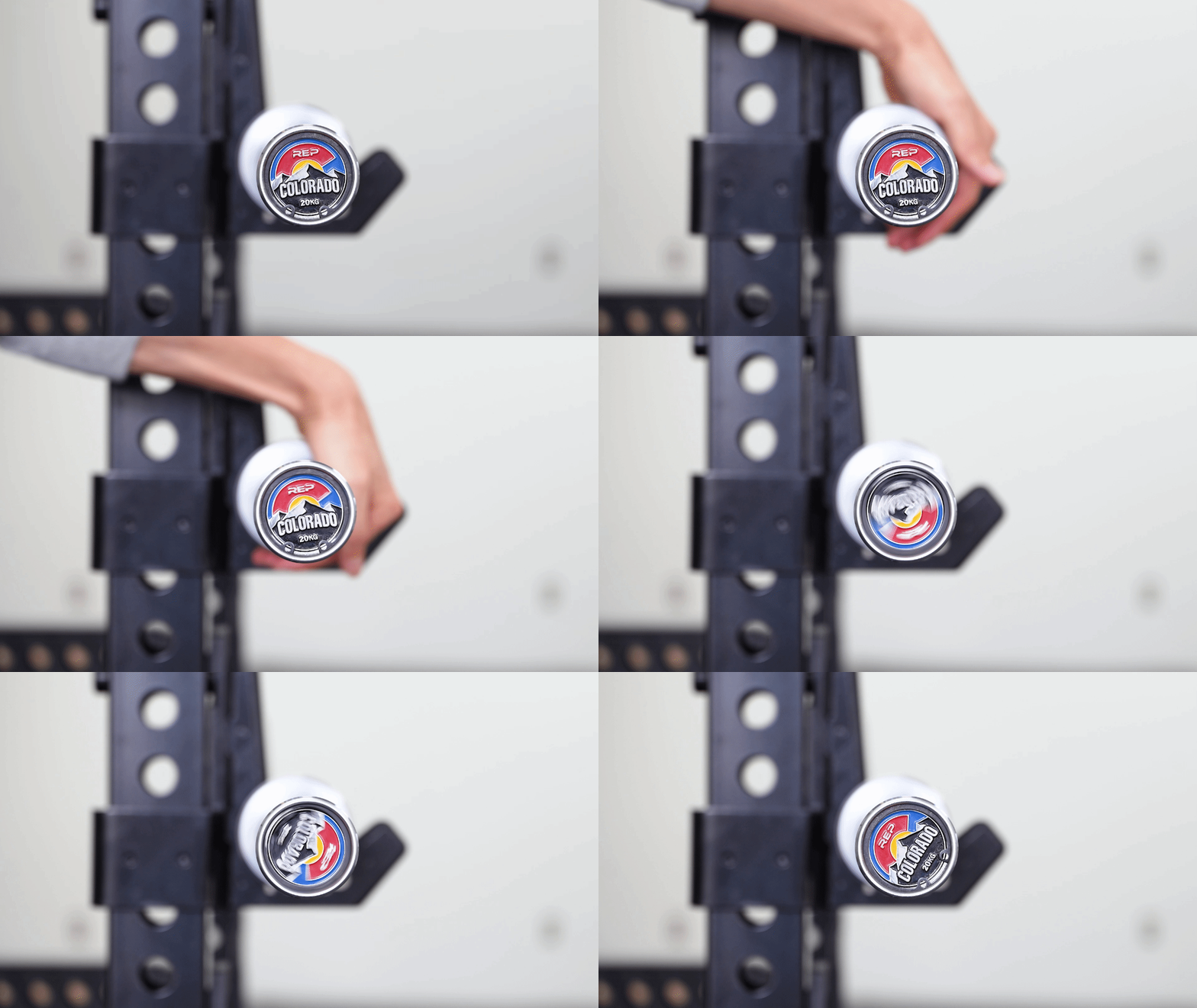
The rotation mechanism will be explained in detail in "2-5. (5) Sleeve Rotation Mechanism", but with a rotation mechanism, the barbell is stable when lifted, and in weightlifting, the weight can be precisely controlled.
Therefore, if you want to perform serious training or are considering training with heavy loads, choose an Olympic bar.
2-1-2. Standard Bar
Compared to Olympic bars, standard bars have a thinner shaft and thinner sleeves for attaching plates.
General characteristics of standard bars are as follows:
[Standard Bar Specifications]
| Standard Bar | |
| Shaft Diameter | 28mm |
| Sleeve Diameter | 28mm |
| Length | Often shorter |
| Weight | Around 10kg |
| Price | Often cheaper |
| Recommended for | Not handling heavy loads / wanting lower price |
Standard bars are thin and light, and often have lower strength.
Therefore, they are recommended for training beginners who don't handle very heavy weights.
They are also cheaper to purchase compared to Olympic bars.
However, it is important to note that standard bars can only accommodate 28mm diameter plates.
Many barbell plates sold are designed for Olympic bars, and may not fit standard bars.
Also, the shaft length is shorter, so there are cases where they cannot be used with some power racks, so be sure to check thoroughly before purchasing.
2-2. (2) Shaft Diameter
When choosing a barbell, make sure to check the shaft diameter.
Shaft diameter refers to the size of the diameter of the shaft part, as shown in the figure below.

The recommended shaft diameter differs depending on the training purpose, so please refer to the table below when choosing. However, for standard bars, only a 28mm shaft diameter is available.
[Shaft Diameter | Recommended Specifications]
| Powerlifting / BIG3 focused | 29mm |
| Weightlifting | 28mm |
| Multi-purpose | 28.5mm |
Olympic bar diameters are generally 29mm, 28.5mm, and 28mm.
We will explain the characteristics of each in detail.
2-2-1. 29mm | Recommended for Powerlifting and BIG3-focused Training
29mm is the same diameter as barbells for powerlifting competitions.
The shaft is stiff and has minimal flex, so even when performing exercises like squats and bench presses, the ends of the shaft are less likely to touch, avoiding unnecessary strain.
Therefore, 29mm is recommended for powerlifters as well as those performing BIG3 with heavy loads.
2-2-2. 28mm | Recommended for Weightlifting Exercises
28mm is the same diameter as barbells used in weightlifting competitions.
Compared to 29mm, it features greater whip. Greater whip makes it easier to pull the barbell up when lifting it.
Therefore, 28mm is recommended for weightlifters and those training in weightlifting movements such as cleans and snatches.
2-2-3. 28.5mm | Recommended for those who do various multi-purpose training
The 28.5mm is a multi-purpose barbell designed to perform any type of training.
Therefore, beginners who want to perform various types of training or whose training regimen is not yet decided should choose a 28.5mm barbell.
2-3. (3) Knurling
Knurling refers to the rough, textured part of the shaft that serves as an anti-slip grip.
There are three main types of knurling: "Mountain type," "Volcano type," and "Hill type."
When choosing a barbell, the recommended type of knurling varies depending on the training exercise, so let's check it carefully. The recommendations are as follows:
[Knurling | Recommended Specifications]
| Powerlifting / BIG3 focused | Mountain Type |
| Weightlifting / Multi-purpose | Volcano Type / Hill Type |
Understand the characteristics of each and choose the knurling that suits you.
2-3-1. Mountain Type

Mountain type features a rough texture with pronounced protrusions, making it less prone to slipping.
It is mainly adopted for powerlifting barbells.
Due to its exceptionally strong grip, it is recommended for powerlifters as well as those performing BIG3 with heavy loads.
However, its high grip strength also presents the disadvantage of being more likely to damage the palms, so it is not recommended for weightlifting or those who do not handle heavy loads.
2-3-2. Volcano Type

Volcano type knurling has a shape resembling a volcano, characterized by a concave tip.
It provides a good grip without the risk of digging into your hands as much as the mountain type.
Commercial gyms often feature volcano type knurling, making it recommended for various types of training.
Volcano type barbells are also widely used in weightlifting and CrossFit.
2-3-3. Hill Type

Hill type is characterized by its shallow texture and almost flat surface.
It offers less grip than mountain or volcano types, so it's not recommended for powerlifting or heavy BIG3 exercises.
On the other hand, it puts less strain on the skin, making it recommended for weightlifting technique training and light-weight exercises.
2-4. (4) Shaft Mark Position
The shaft mark position refers to the knurled part of the shaft that you grip.
When choosing a barbell, be sure to check the shaft mark position, which serves as a guide for your grip width. The recommended position varies depending on the training exercise, so refer to the table below when making your selection.
[Shaft Mark Position | Recommended Specifications]
| Powerlifting / BIG3 focused | 81cm line |
| Weightlifting | 91cm line |
| Multi-purpose | Marked on both |

Shaft mark positions are typically at 81cm and 91cm, and some have marks at both.
81cm is for powerlifting competition specifications, and 91cm is for weightlifting competition specifications.
If you are not a competitor, it is good to choose a barbell with marks at both positions so you can do both types of training.
2-5. (5) Sleeve Rotation Mechanism
Let's also check the sleeve's bearing rotation mechanism.
Bearings are internal devices that allow the Olympic bar's sleeves to rotate smoothly.
Bearings allow the barbell to rotate smoothly when lifting weight plates. This rotation mechanism stabilizes the barbell and allows the lifter to precisely control the weight.
The recommended specifications for the rotation mechanism differ depending on the type of training, so refer to the recommended specifications below when choosing the sleeve rotation mechanism.
[Sleeve Rotation Mechanism | Recommended Specifications]
| Powerlifting / BIG3 focused / Multi-purpose | Bushing |
| Weightlifting | Needle Bearing |
For differences in sleeve rotation mechanisms, please watch the video below.
2-5-1. "Bushing" for Powerlifting, BIG3-focused, and Multi-purpose Use
Powerlifting involves linear and slow movements, so smooth rotation is not necessary. Therefore, "bushing" as shown in the image below is recommended.

Especially for training with heavy plates, if the rotation is too smooth, the movement can become unstable.
Choose bushing if you are training with heavy weights or performing various types of training.
2-5-2. "Needle Bearings" for Weightlifting
For training that requires fast, dynamic movements, such as weightlifting, "needle bearings" as shown in the image below are recommended.

Especially for athletes performing movements like snatches, cleans, and jerks with heavy plates attached, poor rotation can cause the shaft, which is the axis, to spin in their hands, potentially leading to hand injuries.
Therefore, choose sleeves that use smooth-rotating needle bearings.
2-6. (6) Sleeve Style
Barbell sleeves come in various types, so it's important to choose the right sleeve for your purpose.
The main sleeve styles are broadly divided into the following two:
[Sleeve Styles]
| Style |
Ribbed Finish  |
Smooth Sleeve (No Ribbing)  |
| Features | ・Sleeve has a jagged texture ・Plates are less likely to slip |
・Sleeve has no texture ・Easier to change plates |
We will explain the characteristics of each in detail.
2-6-1. Sleeve Style "Ribbed Finish"
| Style |
Ribbed Finish |
| Features | ・Sleeves have a serrated finish ・Plates are less likely to slip |
A ribbed finish, as shown in the image above, refers to the serrated processing on the sleeve.
The key feature of the ribbed finish is that it prevents plates from slipping on the sleeve.
In particular, when a ribbed sleeve is combined with competition bumper plates, the grooves in the two friction surfaces interlock, making the plates less likely to shift. This combination results in a distinctive frictional or metallic sound when plates are loaded or unloaded, making it easier to detect plate shifts and increasing safety.
However, if using in a home gym, be aware that it may cause noise issues for neighbors.
Many barbells with this ribbed finish are sold for weightlifting and CrossFit.
2-6-2. Sleeve Style "Non-Ribbed (Smooth Sleeve)"
| Style |
Non-Ribbed (Smooth Sleeve) |
| Features | ・No processing on the sleeve ・Easy to change plates |
Sleeves without a ribbed finish (smooth sleeves) are characterized by how easy it is to change plates.
Since there is less friction noise between the sleeve and the plate, they can be used safely in a home gym.
Therefore, this type is recommended for general trainees.
2-7. (7) Sleeve Surface Treatment
The sleeve portion of a barbell is subject to repeated friction and impact with plates, so it requires a different type of surface treatment than the shaft portion.
Refer to the list below for the types and characteristics of sleeve surface treatments.
[Sleeve Surface Treatments]
| Type of Surface Treatment | Characteristics | Recommendation Level |
| Chrome Plating | ・Resistant to friction and impact with metal ・Good slipperiness ・Easy to attach and detach plates |
★★★★☆ |
| Stainless Steel | ・No worries about rust or peeling coating | ★★★★★ |
| Zinc Plating | ・Resistant to friction and impact with metal ・Good slipperiness ・High corrosion resistance, strong against rust |
★★★☆☆ |
Understand the characteristics of each and choose the most suitable one.
2-7-1. Chrome Plating
Chrome plating is strong against friction and impact with metal, and has good slipperiness, making it ideal for the surface treatment of the sleeve portion where plates are attached and detached.
Many barbells use chrome plating, making it the most standard sleeve surface treatment.
It is a recommended surface treatment for any type of training.
2-7-2. Stainless Steel
Stainless steel does not have a surface coating and has been widely adopted in high-end products in North America in recent years.
It is more rust-resistant than chrome plating and there is no concern about the coating peeling, making maintenance very easy and comfortable to use.
However, the downside is that it is more expensive compared to other products.
2-7-3. Zinc Plating
Zinc plating, like chrome plating, is strong against friction and impact with metal and has good slipperiness.
However, it is not as hard as chrome plating, so it wears out a bit faster and discolors with age.
However, it has the characteristic of being strong in corrosion resistance, comparable to chrome plating.
2-8. (8) Shaft Surface Treatment
Barbell surface treatments are diverse, and anti-rust properties, corrosion resistance, grip strength, etc., vary greatly depending on the treatment method.
The main shaft surface treatments for barbells sold in Japan can be divided into the following six types. An overview of the characteristics of each is provided below.
[Shaft Surface Treatments]
| Type of Surface Treatment | Characteristics | Recommendation Level |
| Chrome Plating | ・Excellent anti-rust, corrosion resistance, and wear resistance ・Moderate grip strength |
★★★★☆ |
| Zinc Plating | ・Excellent corrosion resistance and friction ・Moderate grip strength ・Discoloration due to aging |
★★★☆☆ |
| Nickel Plating | ・Excellent corrosion resistance ・Beautiful golden luster, resistant to discoloration |
★★★★☆ |
| Cerakote | ・High corrosion resistance and anti-rust properties ・Wide range of vivid and stylish colors |
★★★★☆ |
| Stainless Steel | ・Excellent anti-rust properties ・Strong grip ・Easy to maintain |
★★★★★ |
| Black Oxide (Blackening) |
・Very thin film, easily scratched ・Low corrosion resistance and anti-rust properties |
★★★☆☆ |
The characteristics and price vary depending on the processing method, so be sure to check carefully and choose the optimal barbell.
2-8-1. Chrome Plating
Chrome plating features a beautiful luster and is strong against rust and wear. It is the most commonly used barbell coating and can be considered the standard.
In particular, competition weightlifting shafts are always chrome-plated by rule.
However, there are two types of chrome plating: hard chrome plating and decorative chrome plating. Be aware that some products use decorative chrome plating, which has low durability.
Such products may experience rust or peeling plating within a short period.
2-8-2. Zinc Plating
Zinc plating surpasses chrome plating in terms of corrosion resistance and friction, and among metal platings, it offers a particularly good grip feel.
However, its wear resistance is inferior to chrome plating, and discoloration due to aging is unavoidable.
While inexpensive, it has high rust resistance, and in addition to silver, black and gold colorings are stylish and popular.
2-8-3. Nickel Plating
Nickel plating is characterized by excellent corrosion resistance.
It has a beautiful, slightly yellowish, golden luster and is resistant to discoloration, making it an excellent choice.
While slightly more expensive, it is a high-quality and luxurious finish.
2-8-4. Cerakote
Cerakote is not a metal plating but a coating applied with a ceramic-based coating material.
It offers extremely high corrosion and rust resistance, and is characterized by vibrant colors. Many manufacturers sell barbells with ceramic coatings.
However, be aware that some manufacturers may have a poor surface finish, causing it to peel off easily when rubbed against J-cups or safeties.
2-8-5. Stainless Steel
Stainless steel refers to barbells that do not have any surface treatment.
Although expensive, it is strong against rust and has a strong grip due to the absence of surface treatment.
Also, it is easy to maintain, making it recommended for introduction in commercial gyms and other places used by many people.
2-8-6. Black Oxide (Blackening)
Black oxide is a treatment method where an object is immersed in an alkaline aqueous solution to cause a chemical reaction, forming a black oxide film on the metal surface.
Although the term "blackening" suggests coloring with paint, the surface is intentionally rusted to prevent further rust progression.
Black oxide has a thin film, so its anti-corrosion and anti-rust properties are not very high, but it is processed at a low cost, offering the advantage of being inexpensive.
2-9. (9) Tensile Strength
Finally, let's check the tensile strength. Choose a barbell with a tensile strength of 190K PSI or higher.
[Tensile Strength | Recommended Specifications]
| Tensile Strength | 190K PSI or higher |
Tensile strength is one of the values indicating the strength of a material, representing the maximum tensile stress a material can withstand before breaking when a tensile load is applied.
Simply put, when a load is applied to a barbell and it bends, if the limit is exceeded, the barbell will not return to its original shape, and further loading will cause it to break. This value just before breaking is the tensile strength.
The higher the tensile strength, the stronger the barbell is against breakage, but humans do not train with weights close to the breaking point of a barbell.
Therefore, a barbell with 190K PSI or higher, which is handled by many commercial manufacturers, can be used safely by anyone, regardless of whether it's for a home gym or a commercial gym.
3. [Professionally Selected] 8 Recommended Barbells

Up to this point, we have explained how to choose a barbell and the key points to check. From here, we will introduce our recommended barbells.
We will introduce them by purpose of use, so please refer to them to choose a barbell that suits your training exercises and intended use.
[Recommended Barbells by Purpose of Use]
| For people primarily training the BIG3 |
| ・REP Fitness|Delta Basic Bar ・REP Fitness|Double Black Diamond Power Bar |
| For those setting up in commercial gyms or school facilities |
| ・REP Fitness|Colorado Bar ・IVANKO|Standard Olympic Bar 20kg |
| For powerlifting competitors |
| ・REP Fitness|Double Black Diamond Power Bar ・ELEIKO|IPF Stainless Powerlifting Training Bar |
| For weightlifting competitors |
| ・REP Fitness|Mesa Technique Bar ・ELEIKO|Weightlifting Training Bar |
Check the links for the purpose of use you are interested in to see the recommended products for each.
3-1. For people primarily training the BIG3
Here are two recommended products for people primarily training the BIG3:
[For people primarily training the BIG3]
| ・REP Fitness|Delta Basic Bar ・REP Fitness|Double Black Diamond Power Bar |
Let's take a closer look at the features and specifications of each product.
3-1-1. REP Fitness|Delta Basic Bar

Source: UCHINO
[Detailed Specifications]
| Type | Olympic Shaft |
| Shaft Diameter | 29㎜ |
| Knurling | Volcano type |
| Shaft Mark Position | 81cm・91cm both |
| Sleeve Rotation Mechanism | Bushing |
| Price | 32,900 yen (tax included) |
The REP Fitness Delta Basic Bar is recommended for those focusing on BIG3 training.
With a slow rotation and brass bushing sleeves designed for strength, it is also ideal for powerlifting.
The knurling is volcano-shaped, providing good grip without hurting the hands.
As a basic barbell, it is also recommended for those engaging in multi-purpose training.
|
[Amazon Customer Review] ★★★★★ |
3-1-2. REP Fitness|Double Black Diamond Power Bar

Source: UCHINO
[Detailed Specifications]
| Type | Olympic Shaft |
| Shaft Diameter | 29㎜ |
| Knurling | Mountain type |
| Shaft Mark Position | 81cm |
| Sleeve Rotation Mechanism | Bushing |
| Price | 51,800 yen (tax included) |
The REP Fitness Double Black Diamond Power Bar is a premium powerlifting barbell with fine knurling.
It is the ideal barbell for BIG3-focused training.
The shaft is available in Cerakote or stainless steel, offering excellent corrosion and rust resistance.
|
[Amazon Reviews] ★★★★★ ★★★★★ ★★★★★ |
3-2. For those introducing barbells to commercial gyms, school facilities, etc.
For multi-purpose use in commercial gyms, school facilities, etc., we recommend the following two barbells:
[For commercial gyms, school facilities, etc.]
| ・REP Fitness|Colorado Bar ・IVANKO|Standard Olympic Bar 20kg |
Let's take a closer look at the features and specifications of each product.
3-2-1. REP Fitness|Colorado Bar

Source: UCHINO
[Specifications]
| Type | Olympic Shaft |
| Shaft Diameter | 28.5mm |
| Knurling | Volcano type |
| Shaft Mark Position | Both 81cm and 91cm |
| Sleeve Rotation Mechanism | Bushing |
| Price | 57,300 yen (tax included) |
The Colorado Bar from REP Fitness is a versatile barbell that can be used for various multi-purpose training activities such as powerlifting, weightlifting, and CrossFit.
The sleeves use composite bushings, which provide excellent sound dampening during drops and smooth rotation.
The shaft is available in two types, Cerakote or hard chrome, both offering excellent corrosion and rust resistance.
|
[Amazon Reviews] ★★★★★ ★★★★★ Additionally, the detailed work on the end caps and sleeves satisfies my desire for ownership. |
3-2-2. IVANKO|Standard Olympic Bar 20kg

Source: Fitness Shop
[Specifications]
| Type | Olympic Shaft |
| Shaft Diameter | 28mm |
| Knurling | Volcano type |
| Shaft Mark Position | Both 81cm and 91cm |
| Sleeve Rotation Mechanism | Bushing |
| Price | 63,800 yen (tax included) |
IVANKO's barbells have a proven track record of being adopted by fitness clubs worldwide.
The Standard Bar 20kg is suitable for various training exercises, making it recommended for multi-purpose use in commercial gyms and school facilities.
3-3. For Powerlifting Competitors
For powerlifting competitors, we recommend the following two barbells:
[For Powerlifting Competitors]
| ・REP Fitness|Double Black Diamond Power Bar ・ELEIKO|IPF Stainless Powerlifting Training Bar |
Let's take a closer look at the features and specifications of each product.
3-3-1. REP Fitness|Double Black Diamond Power Bar
Source: UCHINO
[Specifications]
| Type | Olympic Shaft |
| Shaft Diameter | 29mm |
| Knurling | Mountain type |
| Shaft Mark Position | 81cm |
| Sleeve Rotation Mechanism | Bushing |
| Price | 51,800 yen (tax included) |
The REP Fitness Double Black Diamond Power Bar is a top-of-the-line powerlifting barbell featuring fine knurling.
This barbell is recommended for powerlifting competitors.
The shaft is available in Cerakote or stainless steel, both offering excellent corrosion and rust resistance.
|
[Amazon Reviews] ★★★★★ ★★★★★ ★★★★★ |
3-3-2. ELEIKO|IPF Stainless Powerlifting Training Bar

Source: MBC POWER
[Specifications]
| Type | Olympic Shaft |
| Shaft Diameter | 29mm |
| Knurling | Mountain type |
| Shaft Mark Position | 81cm |
| Sleeve Rotation Mechanism | Bushing |
| Price | 196,100 yen (tax included) |
ELEIKO is a world-leading brand of free weights based in Sweden.
Many of their products have been used in international competitions such as Olympic weightlifting and powerlifting for many years, and are supported by athletes with the most discerning eyes.
The IPF Stainless Powerlifting Training Bar has performance equivalent to the world standard for powerlifting competition barbells. With a high-quality Swedish stainless steel shaft, it offers excellent grip and corrosion resistance, making it arguably the world's best powerlifting bar.
|
[Reviews] ★★★★★ |
3-4. For Weightlifting Competitors
For weightlifting competitors, we recommend the following two barbells:
[For Weightlifting Competitors]
| ・REP Fitness|Mesa Technique Bar ・ELEIKO|Weightlifting Training Bar |
Let's take a closer look at the features and specifications of each product.
3-4-1. REP Fitness|Mesa Technique Bar

Source: UCHINO
[Specifications]
| Type | Olympic Shaft |
| Shaft Diameter | 28mm |
| Knurling | Hill type |
| Shaft Mark Position | Both 81cm and 91cm |
| Sleeve Rotation Mechanism | Bushing |
| Price | 29,900 yen (tax included) |
The Mesa Technique Bar is a training bar designed for beginners, making it ideal for learning proper lifting techniques.
The knurling is a gentle "hill" type, providing sufficient grip for light-weight exercises.
This bar is compatible with standard 50mm diameter plates. Additionally, the sleeves have ribs designed to prevent plates from shifting during explosive movements.
|
[Amazon Reviews] ★★★★★ |
3-4-2. ELEIKO|Weightlifting Training Bar

Source: MBC POWER
[Specifications]
| Type | Olympic Shaft |
| Shaft Diameter | 20mm |
| Knurling | Hill type |
| Shaft Mark Position | 91cm |
| Sleeve Rotation Mechanism | Needle Bearing |
| Price | 213,100 yen (tax included) |
ELEIKO is a world-leading brand of free weights based in Sweden.
The Weightlifting Training Bar is an International Weightlifting Federation (IWF) certified product specifically designed for Olympic weightlifting training, used by the highest-level lifters in training facilities and gyms worldwide.
The Weightlifting Training Bar offers the same feel and performance as competition weightlifting bars.
The mild knurling reduces skin irritation, making it suitable for high-volume lifting.
Summary
In this article, we have thoroughly discussed recommended barbells. Let's summarize.
When choosing a barbell, it is important to select based on your intended use and training type.
Here's how to choose a barbell based on its intended use:
[How to Choose a Barbell by Intended Use]
| Specs | Powerlifting Focus on BIG3 |
Weightlifting | Multipurpose |
| Shaft Diameter | 29mm | 28mm | 28.5mm |
| Knurling | Mountain | Volcano Hill | Volcano Hill |
| Shaft Mark Position | 81cm line | 91cm line | Marked on both |
| Sleeve Rotation Mechanism | Bushing | Needle bearing | Bushing |
When choosing a barbell, also be sure to check the following 9 points.
[Barbell Selection Checklist]
|
(1) Barbell Type (2) Shaft Diameter (3) Knurling (4) Shaft Mark Position (5) Sleeve Rotation Mechanism (6) Sleeve Style (7) Sleeve Surface Treatment (8) Shaft Surface Treatment (9) Tensile Strength |
When you search for barbells on shopping sites, you'll find countless manufacturers and products, and many people don't know which one to choose.
Buying for reasons like "it's cheap" or "good reviews" often leads to failure because it doesn't suit you.
To avoid this, make sure you understand the checklist and choose the barbell that's right for you.
I hope this article helps those who are struggling to choose a barbell.


